by Isvara Larwood (age 10)
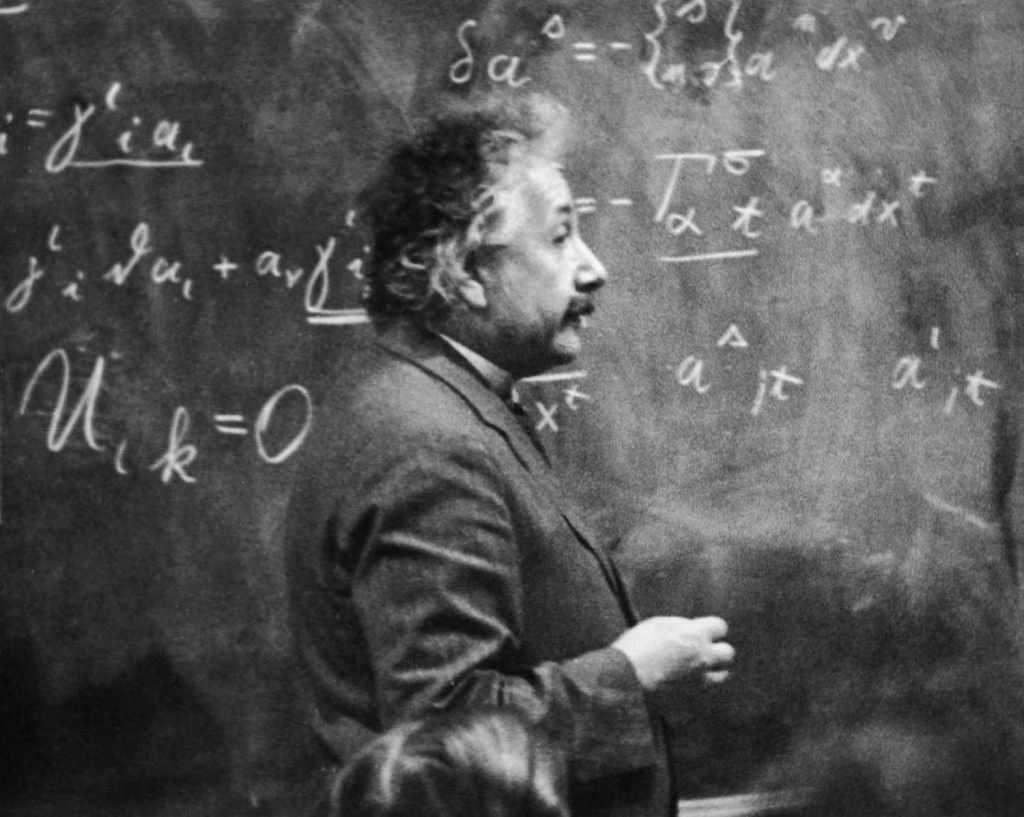
I chose to research Albert Einstein because he is famous for being a genius. He viewed creativity and imagination as essential components of human potential. He also stood for peace in the world and was vegetarian (like me). In a letter dated 30th March 1954, he wrote, “There is no fat, meat or fish in my life anymore. It actually feels great.”
Albert was born in Germany in 1879. It took him 4 years to say his first word, and for a while his little sister Marga was his only friend. At age 5, his father gave him a pocket compass which became his favourite toy as he thought there was something magical about the needle, and was very curious to know how it worked. Albert didn’t like school at all, but at home he loved learning about Physics and Maths and trying to prove theories on his own.
As a teen, Albert published his first scientific paper, and, after studying Maths and Physics in Switzerland, he got a job in a patent office. Although many new inventions were recorded at his workplace, the ideas he was working on at home were a lot more interesting and groundbreaking.
His curiosity led him to explore space and time and discover one of the most famous formulas in the world, the theory of relativity. It explains how speed affects mass, time and space. When Albert was proved right on an experiment, every university in the world wanted to meet the scruffy scientist with the crazy hair.
Albert won a Nobel prize for discovering photons, the tiny particles that light is made of. He didn’t attend the ceremony as he was too focused on travelling and sharing his knowledge. He was received with honour in many countries in the world, but back home the Nazis had taken control of Germany. Albert and many of his colleagues were Jewish and so were in danger; they had to leave for America. Albert convinced governments and universities to hire Jewish scientists so many of them were able to escape Germany too.
When the war broke out in Europe, Albert feared that the Nazis could use his discoveries to create the most terrible weapon in the world: a nuclear bomb. He sent a letter warning the president of the US. He always regretted signing that letter, as it led to the US making their own nuclear bomb. Albert had always stood for peace; he thought science should only be used for good. That’s why he refused to be involved in the creation of such a weapon.
By always questioning everything, little Albert became one of the most original minds of the 20th century. He believed that creativity and artistic expression unlocked our ability to be innovative, think of new ideas and help us to problem-solve, not just in the realm of science, but in all areas of our life.
 Word Oysters