by Stephen Patch (age 15)
To date, war has killed roughly 4 billion people. One of the more famous war quotes is from William Tecumseh Sherman, who simply said, “War is hell”.
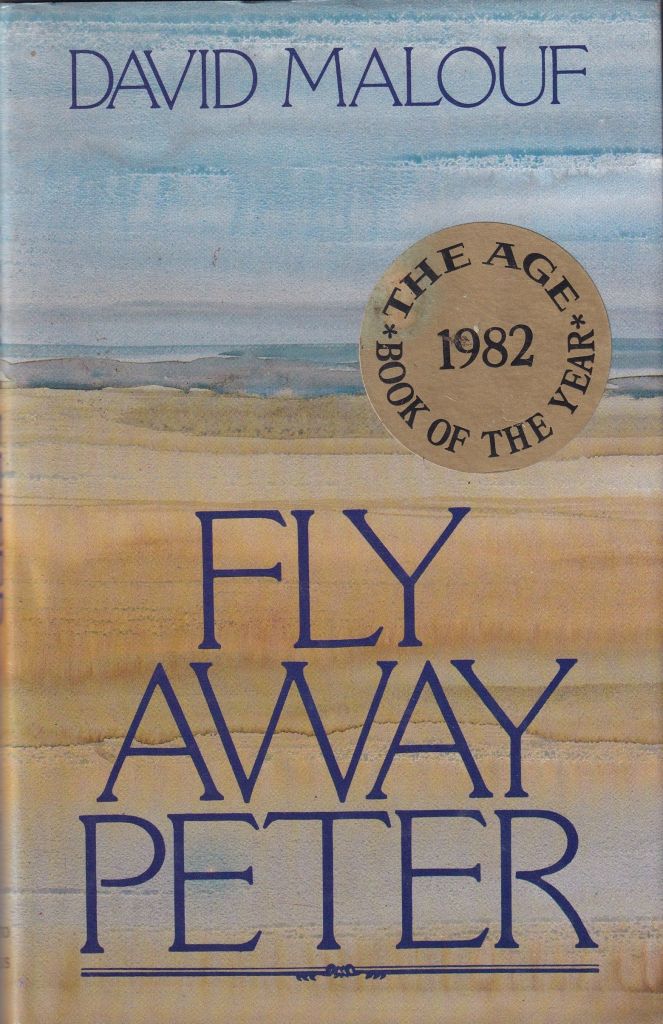
In 1982, David Malouf published his novel Fly Away Peter, which pictures war in much the same light. The book follows a devoted bird watcher, Jim Saddler, who is prodded from his beloved mudflats of coastal Queensland by the ‘Great War’ and sent to the mud-filled trenches, where he dies.
Malouf clearly depicts war as enslaving and cruel through its manipulation of Jim by others’ expectations, his fear of missing out, and eventually by driving Jim to despair. Malouf effectively demonstrates this by using many literary devices, most notably the birds Jim watches as symbols of freedom. Malouf places images of these birds alongside scenes of war where Jim is being controlled or restricted. Thus, Malouf juxtaposes the freedom of the birds with the enslavement of war, highlighting war’s manipulative nature.
First, the book shows the war is an enslaving tyrant because it manipulates Jim through others’ expectations. An early example occurs when news of war first arrives in Australia, and all of “sleepy Brisbane” is in an uproar (Malouf, 1999, p. 42). Certainly, the personification of Brisbane helps Malouf emphasise how the war changed people and their expectations. Indeed, seeing all the excitement and soldiers, Jim feels that “the ground before him had suddenly tilted in the direction of Europe…they were all now on a dangerous slope” (Malouf, 1999, p.37). Malouf uses a powerful metaphor here to show how Jim no longer feels free. Rather, everyone expects him to join up. Furthermore, after the Gallipoli campaign begins, even Jim’s own father begins to talk as if he expects Jim to go. Everyone is suddenly fiercely patriotic, and Jim “feels the drag upon him” (Malouf, 1999, p.56). Here, similar metaphors link the two situations, demonstrating how the war forces itself upon Jim through others’ expectations.
In contrast, Jim’s birdwatching friend contemplates the fact that he cannot own the birds (Malouf, 1999, p. 38). They are not his and are free from the expectations and demands of people. Thus, by placing these scenes close together, Malouf starkly juxtaposes the birds’ freedom with the war’s manipulation.
Secondly, the war imprisons Jim by presenting itself as something he must pass through in order to preserve his future. Jim fears that his life, which “had stretched away to a clear future”, will be lost if he does not go to war (Malouf, 1999, p.37).
He feels that he must go so as to understand why the world is changing; otherwise, he will “spend his whole life wondering what had happened” (Malouf, 1999, p.57). Conversely, Jim knows that “[t]he birds could wait” And that their “timespan was more or less infinite” (Malouf, 1999, p.57). Here, Malouf deliberately uses hyperbole to emphasise the stark contrast between the birds’ freedom and Jim’s lack of freedom. Certainly, Jim no longer feels in control. The war has used change and the fear of being left behind to manipulate him.
Finally, the war seeks to imprison Jim through plunging him into despair. This despair prevents him from having any hope, thus imprisoning his mind. In fact, Malouf resorts to many metaphors to try and describe the darkness of the war that plunges Jim into despair. He describes the fighting as “a nightmare,” the war as a “murderous machine,” and the ground a “sea of mud” that swallows everything it can (Malouf, 1999, p. 106). In Jim’s own words, he had fallen “into a dark pocket of time from which there was no escape” (Malouf, 1999, p.107). Clearly, the war has succeeded in convincing Jim that there is no chance of escape – his mind is firmly trapped.
However, in direct opposition to the evils of war, birds are still present, even on the battlefields. In fact, “to keep hold of himself (Jim) went back to his … birds” (Malouf, 1999, p.111).
Here Malouf resorts to yet another metaphor to show the power of the birds’ little lives of freedom. Their hope and cheerfulness are juxtaposed with the war’s senseless violence and Jim’s dreary imprisonment. Throughout the book, Malouf utilises the birds cleverly to reveal how the war strips Jim of his freedom through expectations, fears of missing out and despair.
In conclusion, Fly Away Peter is an attempt to describe the utter evil and cruelty of war, creating despair and enslaving men. To this end, it utilises birds as a symbol of peace and juxtaposes this with the enslavement that war brings. Certainly, when war occurs, confusion, fear and lack of control is normal. Violence seems to have won. But with God, confusion and enslavement no longer have power. God alone gives freedom – freedom greater than any possessed by the birds he made.
Bibliography:
Malouf, D. (1999). Fly Away Peter. London: Random House.
 Word Oysters