Gauravani Larwood age 14
Why do we see a difference between cows and dogs? Why do we see a cow as dinner and a dog as a beloved companion sleeping in our bed, almost like a child? And why do we assume that meat is really what we should be eating? That it’s “healthy”?
From birth, most people are conditioned to think that eating animals is okay. Even normal. Or, they have niggling thoughts in the back of their mind about the wrongness of it all, but they push those thoughts away. I have grown up knowing without a doubt that eating animals, in other words meat, is morally wrong and unhealthy: physically, mentally, and spiritually.
Firstly, meat is actually very unhealthy, despite what people like to say about it being an essential part of our diet. It has been scientifically proven that meat can lead to many serious health problems including heart disease and cancer of the colon, uterus, rectum, and breast. Various reliable studies have shown that meat is the third biggest killer in the world following tobacco and alcohol.
Why is meat so unhealthy? The human body cannot process excessive amounts of cholesterol and animal fat. When the body is fed too much cholesterol (a substance found in animal products), the extra cholesterol starts to build up on the walls of the arteries, leaving smaller and smaller gaps for blood to flow. This constriction of blood flow can lead to serious health issues like heart disease and strokes. Other dangerous substances in red and processed meat can also lead to cancer, and toxins can overload the kidneys, leading to arthritis and rheumatism.
Another health concern to note is that meat isn’t always that bright red color – as soon as an animal is slaughtered, the flesh starts to turn a disgusting greyish green, so the meat industry adds lots of chemicals and preservatives to give it that bright reddish pink color.
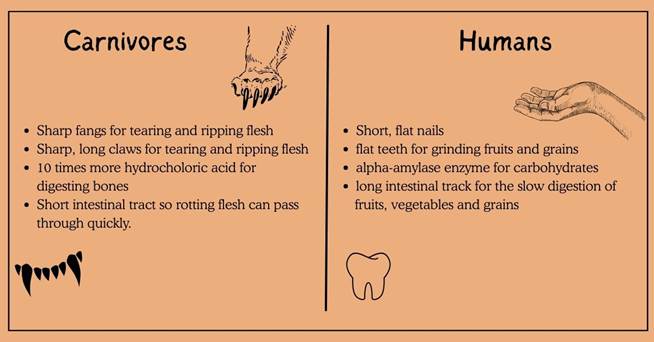
Secondly, after learning about the possible side effects for a meat eater, we need to ask: is the human body designed for a meaty diet? Humans have very flat, even teeth, perfectly designed for the sideways chewing of fresh foods like nuts, fruits, vegetables and grains. This is similar to other herbivores such as cows, goats, deer and rabbits. In addition, humans’ nails are short and flat – not long and sharp like those of flesh-eating carnivorous animals. They have much longer intestines than carnivores too. Carnivores need short intestines so that rotting, toxic flesh can pass quickly though them. Humans, on the other hand, have a much longer intestinal tract, allowing for the slow digestion of fruits, vegetables, and grains. Furthermore, while carnivores have ten times more hydrochloric acid to digest bones, humans have the alpha-amylase enzyme for carbohydrates. Therefore, when you look at the design of the human body, the answer is very simple: Humans are certainly not built to be carnivores, or even omnivores. They are built to be vegetarian.
The table below lays this out clearly:
Thirdly, meat is unhealthy for our spiritual and mental wellbeing. Meat is heavy and dulling to the mind, and the fear that the animal feels upon slaughter can transfer to the mind of consumer, leaving them in an unfavourably dark consciousness.
According to ancient scriptures such as the Vedas and the Bible, we sow what we reap. In other words, whatever actions we commit, good or bad, those actions will come back to us. Anyone who is part of that cycle of meat and death, from the person raising the animals all the way to the person eating them, will have to experience unfavourable results.
Finally, all animals are living beings and should be treated equally, no matter their shape or size. Farm animals are intelligent, sociable and emotional beings with their own individual personalities. They too feel pain.
Farmed animals suffer horrible conditions in slaughterhouses; they are crammed into small spaces and often have teeth or beaks clipped, tails amputated, ears sliced – all without amnesia. These horrors leave the animals in shock for days. Over 80 million precious lives are taken every year so that humans can consume their 350 million tonnes of meat. And the numbers are only increasing, with people today consuming three times the amount of meat eaten fifty years ago.
In conclusion therefore, although eating meat is a “normal”, everyday thing to most people, it’s not in any way ethical. When I go past butchers and shelves of meat, I look away and wonder, “how can people do this?” There are so many reasons to avoid meat – health, kindness, karma, and logic. Are we really meant to be eating dead animals? No! Do we really need to eat animals to survive? No! With the right balance of vegetarian food (to ensure we are getting everything we need), we can live a healthy and peaceful life without taking lives. It’s not too late for you to have a change of heart. Take a challenge, rise up to the truth, and stand up for those who cannot speak our language.
 Word Oysters