by Gabrielle Brenan (age 15)
Foreword
Dear Reader,
Last year, I decided that I wanted to explore the publicly present (but enigmatic) character of Bill Gates.
I found his story interesting, and, given the controversy surrounding his name and activities, I decided to do my own research (and had a lot of fun doing it).
What I found out was strange. He presents well (he’d have to, given how much control he has over mainstream media outlets), but there also appear to be direct conflicts-of-interest between what he says he wants to do and what he actually does.
Just as an example, Gates has had extraordinary control over world health outcomes and initiatives. Given that he is not a doctor or a scientist, this is strange to say the least. He was directing America (and consequently the world) through the Covid-19 pandemic in 2020-22, yet what expertise did he have to do that?
The haze clears slightly when one learns that he is the largest private donor to the World Health Organisation and, until the United States cut funding in early 2024, the second-largest donor overall.
One has to ask oneself: What sort of control does that give him?!
My research has given me some pause for concern, but I have tried to make this biography as objective as possible: the bare facts and little else.
***
On the 26th of October 1955, another child came, squalling, into this world. The proud parents called the child William Henry. Some old and strange habit of calling a child after still-living relatives at play.
We shall skip over the toddler years and the first few years of primary school (which are less documented and not the point of this piece). Come with me, instead, to 1962.
“Century 21”
1962 was the year of the World Fair hosted in Bill’s home city, Seattle. Dubbed “Century 21”, it imagined the future. Strange and amazing inventions crowded the space and Bill was fascinated.
Here was the beginning of the end. Just kidding, the start of a lifelong interest in times not yet come.
School
When Gates describes himself as a child, it basically boils down to two points: he was gifted and hard to manage (not that he thought he needed managing). He enjoyed being in control, and he exerted that power over his parents by being an argumentative smart-alec.
At school, he presented as a strange mixture of intelligence, introverted-ness and playing the ‘class-clown’. This meant that he could be disruptive, and, in an effort to help him settle, his parents moved him to a nearby private school. Lakeside was an old-fashioned, all-boys school, and Gates’ parents thought that it would be more intellectually stimulating for their brainiac of a son.
They weren’t wrong.
Computers and Coding
At Lakeside, there was a computer. Today this is a given in a school (stranger still if there isn’t one). But back in the mid-1960s, computers were rare. They were expensive and difficult to run.
In the computer room, Gates found a tribe and, as he progressed through middle and high school, he spent more and more time in that little room with his mates (particularly, Kent, Paul and Ric), working on all sorts of programs and codes.
Gates and his friends were even hired by some tolerant tech startups, earning quite the name for themselves doing odd jobs (de-bugging code in particular).
Kent Evans (1955 – 1972)
At Lakeside, Bill had a particular friend. His name was Kent and they were in the same grade (unlike their other friends Paul and Ric, who were a couple of years ahead).
They were both intelligent and invested in computers. Together they came up with all manner of plans for the future, pushing and questioning each other. It is very possible that Kent could have been a famous, household name associated with Microsoft and Bill Gates. But the unthinkable happened. In 1972 (aged 17), Kent died in a mountaineering accident.
Paul Allen (1953 – 2018)
After Kent died, Gates threw himself into the school scheduling program that they had been working on together. But with all the variables and different things to take into account, it proved too much work for just one person.
So, Bill contacted Paul Allen. He explained the situation and requested help. Paul (who had already graduated and gone to college) came back for the summer. Over the holidays, the two were given free reign and worked day and night to complete the program, falling asleep at the computer and egging each other on.
During that summer they bonded, becoming like brothers. Very headstrong brothers who argued a lot.
College
By his own account, Bill applied to a number of different universities as he neared the end of high school. He did so partly because he was interested, and partly because his parents wanted him to. But mostly, he applied just to see if he could get in.
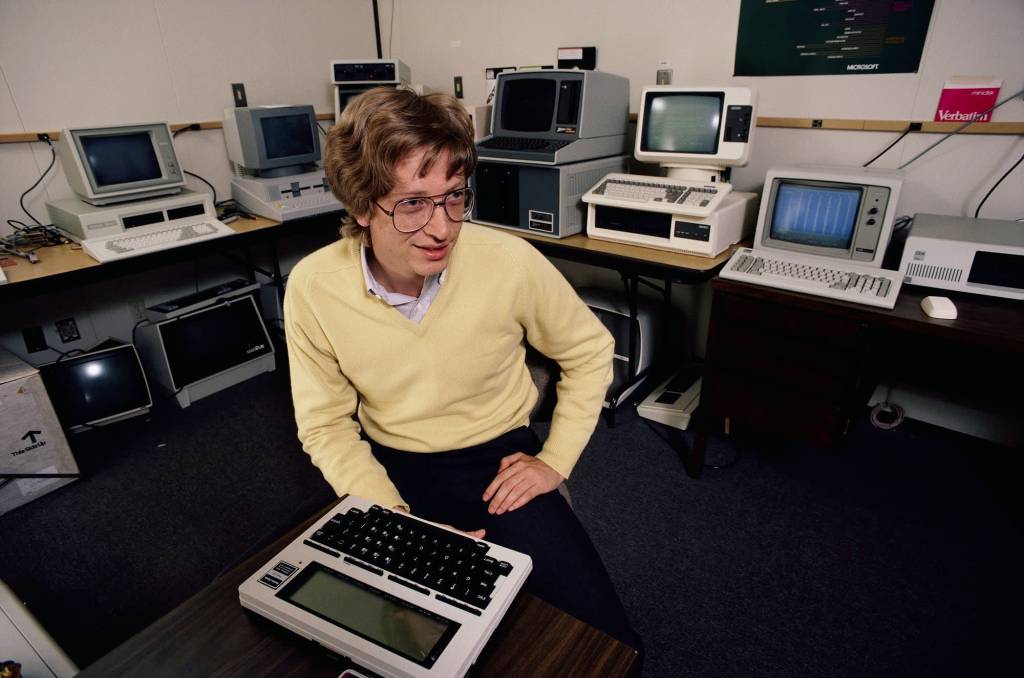
He was accepted into Harvard University (among others) and began his degree there in 1973, studying Mathematics and Computer Science. Here again he spent a lot of time in the computer lab.
But, in 1975, he dropped out, choosing instead to work with Paul on something special.
Altair BASIC
During 1975, Bill and Paul saw a business opportunity that could foster their computer dreams.
The previous year MITS had released the first Personal Computer (PC) with an achievable price-tag.[1] The Altair 8800.
At that point it didn’t include software, which made it difficult to use. So, Bill and Paul (along with a guy called Monte Davidoff) came up with a BASIC Interpreter (Altair BASIC) that allowed for easier usage.[2] They then licensed their achievement, thereby ending the idea that software comes free with the hardware, and making a fair bit of money in the meantime.
Melinda (nee French) Gates
Melinda was born on the 15th of August 1964, and is probably best known for having been married to Bill Gates.
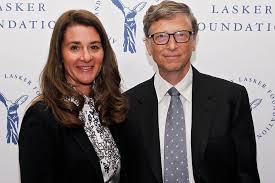
The two met at Microsoft after Melinda joined in 1987. (Mel was Product Manager, and Bill the CEO.) Must’ve felt a bit strange, dating your top boss.
They married on January 1st 1994. Although the couple divorced in 2021 (after 27 years of being married), I don’t think anyone will ever be able to say “Melinda French Gates” without bringing to mind her ex-husband.
Jennifer Katherine Gates
Bill and Melinda had three children over the course of their 27-year marriage. Their first child, born in 1996, was Jennifer. Jennifer is now 29 years old, a paediatrician (child doctor) and is a skilled and enthusiastic horse rider. She is married and has two children of her own. Bill Gates has grandchildren – that’s funny to think about. Not sure why.
World’s Richest Person
Bill was, by all accounts, a hard taskmaster and a challenging co-owner/boss. He was more focused on Microsoft than Paul Allen was (Allen dared to have other interests, and Gates made his displeasure about this clear).
Nonetheless, Bill’s hard and uncompromising work ethic paid off. The company was a booming success and those involved felt the benefits.
In 1997, two years after the release of Windows 95 (a more advanced and modern version of the existing Operating System), Bill Gates was crowned the World’s Richest Person. At the time, his net worth was a whopping $36 billion (roughly $73.5 billion USD in today’s money). His net worth peaked 2 years later (in 1999) at $90 billion (adjusted for inflation, that’s nearly 175 billion USD today).
Over the years, Bill held the title on three separate occasions: from 1997-2007, then in 2009, and again from 2014-2017. And, although he doesn’t currently hold the title (or anywhere near it at the moment), his net worth is still at approximately US $124 billion.[3]
Rory John Gates
Rory is the second of the three siblings, born three years after his sister (in 1999). Despite his influential and publicly present family, Rory is almost a non-figure in the American media. Keeping himself carefully removed from the public eye, the 26-year-old works quietly in policy and intelligence, (data) analysis, and national security.
Phoebe Adele Gates
The last of Bill and Melinda’s children, Phoebe, was born in 2002 and is currently 23 years old.
Despite her relatively young age, she is already an entrepreneur, advocate for women’s rights, and social media influencer. None of this is particularly surprising, in my opinion.
Anti-Trust
In early 1998, there was an investigation done into Microsoft’s business practices.
Whatever was found resulted in an Anti-Trust lawsuit concerning the business and its co-founder/CEO Bill Gates.[4]
At the time, Microsoft had a 95-98% market capture for both software and internet browsing (Internet Explorer was the most popular and pervasive browser).
Along with their monopoly, Microsoft also aggressively prevented other smaller businesses from having a fair go at penetrating what should have been a highly competitive market.
The lawsuit wound on for three long years before finally coming to a head in 2001. In the end, Microsoft was essentially put on probation and had to share its APIs (Application Programming Interfaces) with outside software companies. Nowhere near as bad as it could have been.
Philanthropy and Rebranding
Directly following the lawsuit, Bill Gates stepped down as CEO of Microsoft and gave the position to long-time business partner Steve Ballmer. (However, he retained a position on the Board of Directors). Not long after this, Gates announced the opening of the Bill and Melinda Gates Foundation. And his rebranding as a philanthropist.
At the Foundation, Gates and his team hired experts, researchers and scientists who would join them in helping solve some of the world’s biggest problems. These included, but were not limited to: malaria and polio, hunger and malnutrition, climate change and “green” energy, sanitation and worldwide health (vaccines being high on the agenda).
The Gates Foundation Today
According to the website of the Gates Foundation (the name was changed after Bill and Melinda split), there are currently four major areas of forcus: gender equality, global development, global health, and education.
To expand work in these areas, Bill Gates is still investing hundreds of millions into ideas and places that he believes need more money and attention. He’s not wrong, per se.
He also has a scheme to give away roughly 99% of his fortune back to society through his charitable organisation, all in the next 20 years, before the Foundation is closed at the end of 2045.
Big goals from Bill Gates. Nothing new there.
[1] MITS (Micro-Instrumentation & Telemetry Systems) started as a calculator manufacture but as times changed it evolved to a computer company. It was acquired by Pertech in 1977.
[2] BASIC (Beginners All-purpose Symbolic Instruction Code) is the type of code that made up the Interpreter. An Interpreter is a string of code that interprets and allows outside programs to be run on the device with ease.
[3] I got these numbers from the Madison Trust Company, and adjusted using a US inflation calculator.
[4]Anti-Trust is an American monopoly law that aims to prevent anti-competitive practices (like price fixing) and allow a more even playing field for smaller businesses.
 Word Oysters